
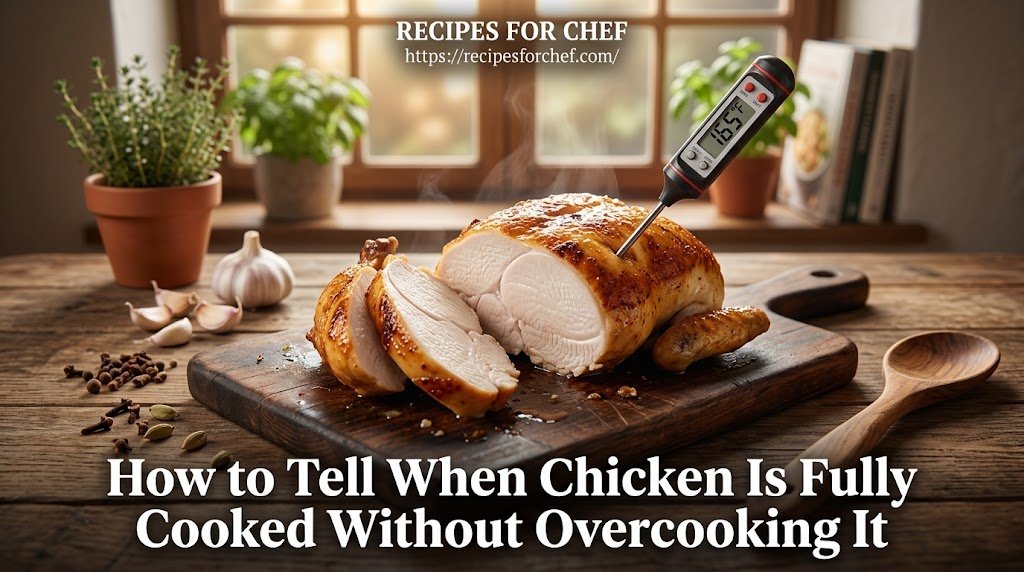
Cooking chicken well is a balance between safety and texture. Undercooked chicken can pose a food-safety risk, while chicken that stays over the heat for too long can become dry, firm, and difficult to enjoy.
The most reliable way to know whether chicken is fully cooked is to check its internal temperature with a food thermometer. For all poultry, the USDA recommends a safe minimum internal temperature of 165°F (73.9°C), measured with a food thermometer.
But temperature is only part of the picture. Learning where to place the thermometer, understanding how different cuts behave, recognizing useful visual cues, and controlling the cooking heat can help you reach that safe temperature without needlessly overcooking the meat.
This guide explains how to check chicken during cooking, what signs to look for, why color alone is unreliable, and how to keep common cuts such as chicken breast, thighs, wings, and ground chicken moist and properly cooked.
Why Chicken Can Be Easy to Overcook
Chicken does not all cook at the same rate.
A thin chicken breast can go from juicy to dry surprisingly quickly, while a thick bone-in thigh may require much more cooking time. A whole chicken also has different parts that heat at different speeds.
Thickness matters as much as weight. A large but thin piece can cook faster than a smaller piece that is unusually thick.
The cooking method also changes the process. A chicken breast cooked in a hot skillet is exposed to direct heat, while chicken baked in a covered dish may heat more gradually. Grilling can produce a browned exterior before the center has finished cooking.
This is why cooking time alone is not a reliable way to decide whether chicken is done.
The thermometer gives you a direct measurement of what is happening inside the thickest part of the meat.
The Most Reliable Way to Tell When Chicken Is Done
The safest and most dependable method is to use a food thermometer.
Insert the thermometer into the thickest part of the chicken, taking care not to touch bone when measuring bone-in pieces. The reading should reach 165°F (73.9°C) for poultry.
For a thick chicken breast, insert the thermometer from the side if possible. This helps the probe reach the center rather than stopping close to the surface.
For a whole chicken, check the thickest parts of the breast and the innermost area of the thigh, avoiding contact with bone. If different areas are still below the safe temperature, continue cooking and check again.
A thermometer is especially useful when cooking unfamiliar cuts or unusually thick pieces because appearance can be misleading.
Where to Insert a Food Thermometer
Correct placement matters.
If the probe is too close to the surface, it may register a temperature that is higher than the center of the chicken. That can make you think the chicken is ready when the thickest portion is not.
For boneless chicken breasts or thighs, aim for the thickest section.
For bone-in chicken, insert the thermometer into the thickest meat without touching the bone. Bone can affect the reading and make the measurement less useful.
If the piece is irregularly shaped, check the thickest area rather than simply measuring the part that looks easiest to reach.
For thin pieces, take care that the tip of the thermometer does not pass all the way through the meat and touch the pan.
Can You Tell by the Color of Chicken?
Color can provide a useful visual clue, but it should not be your main safety test.
Many people were taught that chicken is safe when the center is completely white and unsafe when it is pink. That rule is too simple.
Chicken can change color during cooking for several reasons, and color alone does not tell you the internal temperature. Conversely, chicken can appear cooked on the outside while the center still needs more heat.
The USDA specifically identifies a food thermometer as the reliable way to determine whether poultry has reached a safe minimum internal temperature.
So, if your chicken still looks slightly pink but the thickest part has reached the recommended safe temperature, do not rely on color alone to decide that it needs another long period of cooking.
What the Texture Can Tell You
Texture is useful for judging quality, although it is not a substitute for a thermometer.
Properly cooked chicken should feel firm enough to hold its shape, but it should not feel unusually hard or rubbery.
Chicken breast becomes progressively firmer as it cooks. If it is cooked far beyond the point needed for safety, the muscle fibers can tighten and push out more moisture.
Thigh meat behaves differently. It generally contains more connective tissue and can remain pleasantly tender during longer cooking.
The goal is not simply to make chicken as firm as possible. It is to reach a safe internal temperature while using the cooking method appropriately for the cut.
How to Tell When Chicken Breast Is Done
Chicken breast is one of the easiest cuts to overcook because it is relatively lean.
A boneless breast can become dry if you continue cooking it long after it has reached the safe temperature.
Start checking the thickest part as the chicken approaches the expected cooking time. Once the center reaches 165°F (73.9°C), it has reached the USDA’s safe minimum temperature for poultry.
After cooking, allow the chicken to rest briefly before slicing. This gives the meat a chance to settle and makes it easier to retain some of its juices when cut.
If you slice immediately and see liquid running onto the cutting board, that does not necessarily mean the chicken is undercooked. Use the temperature reading rather than judging safety from the amount of juice.
How to Tell When Chicken Thighs Are Done
Chicken thighs are more forgiving than breast meat because they contain more fat and connective tissue.
For food safety, the same minimum internal temperature applies: 165°F (73.9°C).
However, the texture of thighs may continue improving with additional cooking depending on the recipe. Braised or slow-cooked thighs, for example, can become tender over a longer cooking period.
That does not mean you should automatically cook every thigh to a much higher temperature. Instead, follow the method being used and check the meat as it cooks.
For bone-in thighs, place the thermometer in the thickest portion of meat without touching the bone.
How to Tell When Chicken Wings Are Cooked
Wings are smaller, but their irregular shape makes them difficult to judge by appearance alone.
Check the thickest meaty section with a thermometer, avoiding the bone.
If you are baking or roasting wings, you can also judge their quality by the exterior. A properly cooked wing should have a firm surface, and depending on the recipe, the skin may become browned and crisp.
Remember that crisp skin and safe internal temperature are separate goals. A wing can brown quickly without the thickest portion being fully cooked.
How to Tell When Ground Chicken Is Done
Ground chicken requires particular attention because grinding distributes the meat throughout the mixture.
Ground poultry should be cooked to 165°F (73.9°C) internally.
For chicken burgers, meatballs, patties, or meatloaf, insert the thermometer into the center or thickest section.
Do not judge ground chicken solely by its exterior color. The middle is the part that needs to be checked.
When making several patties, checking one is not always enough if their thickness varies significantly. Thicker pieces may require more time.
Why Cooking Time Alone Is Not Enough
Recipe cooking times are useful estimates, but they are not guarantees.
Your chicken may be thicker or thinner than the author’s. Your pan may distribute heat differently. Your oven may run hotter or cooler than its displayed setting. Starting temperature can also affect how quickly the center heats.
For example, two chicken breasts that weigh the same can have different shapes. One may be thick and compact while another is flatter and wider.
This is why the cooking time tells you when to start checking, while the internal temperature helps you decide when the chicken is ready.
How to Avoid Dry Chicken Breast
The simplest strategy is to stop cooking once the chicken has reached the safe minimum internal temperature rather than leaving it on the heat for an arbitrary extra period.
Thickness also matters.
If a chicken breast is extremely thick at one end, gently flattening it to a more even thickness can help it cook more evenly. This is particularly useful for pan-searing.
Another option is to choose a cooking method suited to the cut. A quick skillet method works well for thinner portions, while thicker pieces may benefit from a gentler cooking process.
Avoid repeatedly cutting the chicken open to check the center. Each cut releases juices and makes it harder to judge the cooking process. A thermometer is a much more useful tool.
Let the Chicken Rest Before Cutting
Once chicken has reached the appropriate internal temperature and is removed from the heat, give it a short rest before slicing when the recipe allows.
Resting is particularly useful for larger pieces such as chicken breasts, thighs, or a whole chicken.
If you cut immediately, juices can run onto the cutting board before you have had a chance to serve the meat.
Resting does not mean leaving cooked chicken sitting out for an extended period. It is simply a short part of the cooking process while you finish the meal.
Common Mistakes That Lead to Overcooked Chicken
Cooking for Much Longer Than the Recipe Suggests
Some cooks add an extra 10 or 15 minutes because they are worried about undercooking.
Instead, begin checking the internal temperature as the estimated cooking time approaches.
Checking the Wrong Part
Measuring the thinnest section gives you less useful information than checking the thickest portion.
Touching Bone With the Thermometer
For bone-in chicken, position the probe in the meat rather than directly against the bone.
Cutting Chicken Open Repeatedly
A small cut can tell you something about appearance, but repeated cutting is an inefficient way to monitor doneness.
Trusting Color Alone
A white interior does not provide the same certainty as a temperature reading. Use the thermometer for the safety decision.
Using Cooking Time as a Guarantee
Times vary with thickness, starting temperature, cookware, oven performance, and cooking method.
How to Cook Chicken More Evenly
Even cooking starts before the chicken reaches the pan.
Try to use pieces that are reasonably similar in thickness when cooking several portions together. If one breast is much thicker than the others, it may still be undercooked when the thinner pieces are already dry.
For pan cooking, avoid overcrowding the pan. Too many pieces can reduce the pan’s heat and encourage steaming rather than the browning you want.
For oven cooking, arrange pieces with some space between them when the recipe calls for roasting or baking uncovered.
If you are using a marinade or sauce, remember that surface moisture can affect browning. Patting chicken appropriately before searing can help develop a better exterior.
What If the Outside Is Brown but the Inside Is Not Done?
This is a common problem with high-heat cooking.
A hot pan, grill, or oven can brown the surface quickly while the center is still heating.
If this happens, lower the heat or move the chicken to a gentler part of the cooking environment and continue cooking until the thickest section reaches the safe temperature.
Do not assume that darker skin or a deeply browned crust means the chicken is fully cooked inside.
This is particularly important with thick breasts, bone-in pieces, and breaded chicken.
Food Safety When Handling Raw Chicken
Safe cooking starts before the chicken reaches the pan.
Keep raw chicken separate from foods that will be eaten without cooking. Use clean utensils and surfaces, and wash your hands after handling raw poultry.
Be careful with cutting boards and knives that have touched raw chicken. They should be cleaned properly before being used for ready-to-eat foods.
The USDA also advises preventing cross-contamination between raw poultry and other foods.
For packaged chicken products that look browned or partially cooked, read the label carefully. Products described as “Cook and Serve,” “Ready to Cook,” or “Oven Ready” may still be raw and require complete cooking according to the package directions.
How to Handle Leftover Chicken
Cooked chicken should be handled promptly after the meal.
Store leftovers appropriately rather than leaving them at room temperature for an extended period. When reheating chicken, heat it thoroughly. USDA guidance states that poultry leftovers should be reheated to 165°F (73.9°C).
For better texture, reheat gently when possible. Very aggressive reheating can dry out lean chicken breast.
Adding a little sauce, broth, or another suitable moist ingredient can help with dishes where the chicken has already lost some moisture.
A Simple Method for Checking Chicken While Cooking
You can make the process much easier by following the same basic routine.
Start with the recipe’s estimated cooking time, but treat it as a guide rather than a guarantee.
As the chicken approaches the expected finishing point, check the thickest part with a food thermometer.
If it has not reached 165°F (73.9°C), continue cooking and check again. If it has reached the safe minimum temperature, remove it from the heat rather than automatically adding extra cooking time.
For larger pieces or multiple portions, check the pieces that are thickest or likely to cook most slowly.
This approach reduces the temptation to keep chicken on the heat “just to be safe.”
Image Opportunities for This Article
[Image suggestion: Food thermometer inserted into the thickest part of a chicken breast]
[Image suggestion: Side-by-side chicken breasts showing different thicknesses before cooking]
[Image suggestion: Proper thermometer placement in a bone-in chicken thigh without touching the bone]
[Image suggestion: Cooked chicken breast sliced to show its moist interior]
[Image suggestion: Ground chicken patty being checked with a digital food thermometer]
Frequently Asked Questions
Can I tell if chicken is cooked by cutting it open?
Cutting chicken open can give you a visual clue, but it is not the most reliable safety check. A food thermometer is the better method because the USDA recommends checking poultry’s internal temperature rather than relying on appearance alone.
What temperature should chicken reach to be safe?
Raw poultry, including chicken breasts, thighs, wings, whole chicken, and ground chicken, should reach a minimum internal temperature of 165°F (73.9°C) when measured with a food thermometer.
Why is my chicken dry even though I cooked it safely?
Chicken can become dry when it remains exposed to heat well beyond the point needed to reach a safe internal temperature. Lean cuts such as breast meat are particularly sensitive to overcooking. Checking the temperature as cooking progresses can help you stop at the right point.
Is slightly pink chicken always undercooked?
No. Color alone is not a reliable way to determine whether poultry is safe to eat. Use a food thermometer to check the thickest part and confirm that it has reached the recommended minimum internal temperature.
Where should I put the thermometer in chicken?
Place the probe in the thickest portion of the meat. For bone-in chicken, avoid touching the bone. With thin pieces, make sure the probe does not pass through the meat and touch the pan.
Should I check every piece of chicken?
If pieces are different sizes or thicknesses, check the thickest pieces and any portions that appear to be cooking more slowly. For several pieces of similar size, use the thermometer to establish when they have reached the safe temperature.
Can I reheat cooked chicken to the same temperature?
Yes. USDA guidance recommends reheating poultry leftovers to 165°F (73.9°C).
Final Thoughts
Knowing when chicken is done becomes much easier once you stop treating cooking time and appearance as the only indicators.
Use cooking time as a starting point, then check the thickest part with a food thermometer. For chicken, the key safety point is 165°F (73.9°C).
From there, good heat control and choosing the right method for the cut can help you avoid leaving the chicken on the heat longer than necessary. That combination gives you a much better chance of serving chicken that is both safely cooked and enjoyable to eat.