
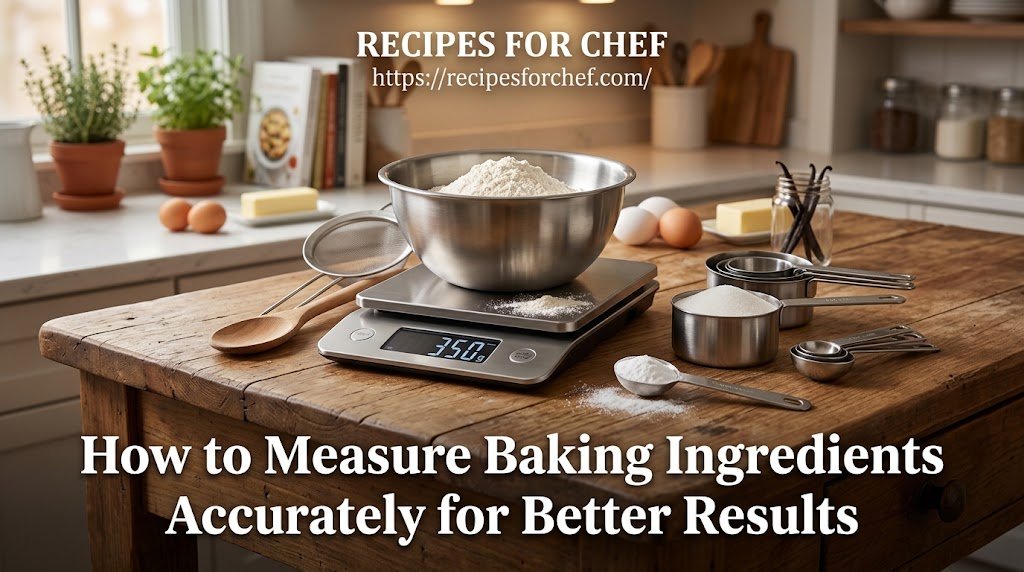
Baking is less forgiving than many other types of cooking. A soup can often handle an extra spoonful of vegetables or a little more broth, but a cake, loaf, cookie, or batch of muffins depends on a much closer relationship between ingredients. A small change in flour, sugar, liquid, or a leavening agent can affect the texture, rise, moisture, and even the time needed in the oven.
That is why accurate measuring matters. You do not need expensive equipment or professional baking skills to improve your results. You mainly need the right measuring method for each ingredient and a consistent way of using it.
This guide explains how to measure common baking ingredients accurately, when to use a kitchen scale, why flour is especially easy to mismeasure, and what to do when a recipe gives measurements in cups, grams, or both. It also covers common measuring mistakes and practical ways to avoid them.
Why Accurate Measuring Matters in Baking
Baking recipes are built around specific proportions. Flour provides structure, liquid hydrates the flour, fat affects tenderness, sugar contributes sweetness and moisture, and eggs can add structure, richness, and liquid. Baking powder and baking soda are used in relatively small amounts, but they can have a noticeable effect on the final result.
If one ingredient is measured incorrectly, the other ingredients no longer have the same balance.
For example, adding too much flour can make cookies thick and dry or turn a cake heavier than expected. Too much liquid can make a batter loose and may change how the finished cake sets. An excess of baking soda can affect both taste and browning.
This does not mean every gram must always be measured with laboratory-level precision. It means that your method should be consistent and appropriate for the ingredient.
For many baking projects, a digital kitchen scale is the most reliable option because weight does not depend on how tightly an ingredient is packed into a measuring cup.
Weight Versus Volume: Which Is More Accurate?
There are two common ways to measure baking ingredients: by weight and by volume.
Weight uses grams, kilograms, ounces, or other units of mass. Volume uses cups, tablespoons, teaspoons, millilitres, and similar measurements.
A cup of flour does not always weigh exactly the same amount. If you scoop directly from a flour container, you may compress the flour and end up with considerably more flour than if you gently spoon it into the cup.
A kitchen scale avoids much of this variation.
When a recipe provides measurements in grams, using a scale is usually the simplest approach. Place the mixing bowl on the scale, tare it to zero, add the first ingredient, tare again, and continue with the next ingredient.
This also reduces the number of dirty measuring cups and makes it easier to follow recipes with several ingredients.
Volume measurements are still useful, especially when a recipe was specifically developed using cups and spoons. The important thing is to use the correct technique rather than treating every ingredient as though it behaves the same way.
The Best Way to Measure Flour
Flour is one of the most commonly mismeasured baking ingredients because it is light and can easily become compacted.
If you scoop flour directly from a deep container with a measuring cup, the cup can pack the flour down. You may end up adding substantially more flour than the recipe intended.
When using volume measurements, use the spoon-and-level method.
First, stir or lightly loosen the flour in its container. Then use a spoon to transfer flour into a dry measuring cup. Let the flour fall loosely into the cup instead of pressing it down.
Once the cup is slightly overfilled, use the straight edge of a knife or similar utensil to sweep across the top and remove the excess.
Do not shake the cup to settle the flour before leveling it. Shaking can compact the flour and change the amount.
If your recipe provides a weight measurement, weighing the flour is preferable because it removes much of this uncertainty.
How to Measure Sugar Correctly
Different types of sugar need slightly different approaches.
Granulated sugar is relatively easy to measure with a dry measuring cup. Fill the cup and level the top without pressing the sugar down unless the recipe specifically says to pack it.
Brown sugar is different. Many recipes expect brown sugar to be packed into the measuring cup because the measurement assumes the sugar has been compressed.
Fill the cup with brown sugar and press it down firmly enough that it holds the shape of the cup when turned out. If the recipe says “packed brown sugar,” do not substitute a loose cup measurement.
Powdered sugar, also called icing sugar or confectioners’ sugar, can settle during storage. If a recipe calls for it by volume, follow the recipe’s instructions regarding sifting. For a weight-based recipe, simply weigh the required amount.
Measuring Butter and Other Solid Fats
Butter can be measured by weight, volume markings on the wrapper, or sometimes by tablespoons.
Weight is straightforward and is particularly useful when a recipe gives butter in grams.
If you are measuring softened butter with a cup, press it firmly into the measuring cup so there are no large air pockets. Level the surface before adding it to the recipe.
Cold butter is often measured using markings on the package and then cut according to the required amount. This can be easier than trying to force hard butter into a measuring cup.
Pay attention to whether the recipe specifies melted, softened, or solid butter. These forms are not automatically interchangeable. Melting butter changes how it behaves in a batter or dough, even when the total amount remains the same.
How to Measure Liquids
Liquid ingredients should generally be measured with a liquid measuring cup rather than a dry measuring cup.
A liquid measuring cup usually has space above the measurement line, making it easier to measure without spilling.
Place the cup on a level surface. Pour the liquid until it reaches the desired mark, then check the level at eye height.
This matters because looking down at an angled measuring cup can make the amount appear correct when it is not.
For very small liquid quantities, such as a teaspoon or tablespoon of vanilla extract, use a measuring spoon rather than trying to estimate the amount in a large cup.
Ingredients such as milk, water, cream, oil, and melted butter should be measured according to the recipe’s specified form.
Measuring Small Ingredients Such as Baking Powder and Baking Soda
Small amounts of baking powder, baking soda, salt, cinnamon, and similar ingredients are usually measured with measuring spoons.
Use a proper measuring spoon rather than a random eating spoon. Household spoons vary in size, so they are not reliable for baking.
Fill the measuring spoon and level it with a straight edge when the recipe calls for a level teaspoon or tablespoon.
Do not automatically assume that a rounded spoonful is acceptable. A little extra baking powder or baking soda can matter because these ingredients are used in much smaller proportions than flour or sugar.
For ingredients that tend to clump, such as baking soda, break up any lumps before measuring so the spoon can be filled evenly.
Dry Measuring Cups and Liquid Measuring Cups Are Not the Same
This distinction causes confusion for many beginners.
Dry measuring cups are designed to be filled to the top and leveled. They are commonly used for ingredients such as flour, sugar, oats, cocoa powder, and other dry ingredients.
Liquid measuring cups are designed to hold liquid below the rim and are marked with measurement lines.
Although both types may use the word “cup,” they are designed for different measuring methods.
Using a liquid measuring cup for flour makes leveling difficult. Using a dry cup to measure a liquid can also be awkward because filling it to the top leaves little room to move the ingredient without spilling.
The difference is mainly about measurement technique and convenience rather than the physical meaning of a cup.
Why a Digital Kitchen Scale Is So Useful
A digital kitchen scale is one of the simplest upgrades you can make if you bake regularly.
It allows you to measure ingredients by weight and makes recipes easier to repeat. If a cake turns out exactly the way you like it, weighing the ingredients gives you a reliable way to reproduce the same proportions later.
A scale is especially useful for flour, cocoa powder, oats, nuts, chocolate, and other ingredients whose volume can vary depending on how they are packed.
The tare function is particularly helpful. Put your mixing bowl on the scale and press the tare button to return the display to zero. Add the first ingredient. Tare again, then add the next one.
This method can make a multi-ingredient recipe surprisingly quick.
If your scale can switch between grams and other units, check the recipe carefully before measuring. Do not confuse grams of weight with millilitres of volume simply because both appear as numbers on a recipe.
How to Measure Ingredients When a Recipe Gives Cups and Grams
When a recipe provides both cups and grams, use the weight measurement if you have a kitchen scale.
The gram measurement is generally more reproducible because the weight does not depend on how an ingredient was packed into a cup.
If you only have cups and spoons, follow the recipe’s intended measuring method.
Avoid searching for a random online conversion for every ingredient. A cup of one ingredient does not have the same weight as a cup of another ingredient. Even within the same ingredient, different measuring methods can produce different weights.
For this reason, ingredient-specific conversions are more useful than treating one universal cup-to-gram conversion as accurate for everything.
Ingredients You Should Not Pack Unless the Recipe Says So
One of the easiest ways to add too much of an ingredient is to pack something that was supposed to remain loose.
Flour, cocoa powder, shredded coconut, oats, and similar dry ingredients are generally measured by filling and leveling unless the recipe specifically gives another instruction.
Brown sugar is a common exception because recipes frequently call for it to be packed.
The wording matters. “1 cup brown sugar, packed” is not the same instruction as “1 cup flour.”
If you are unsure, check whether the recipe provides a weight measurement. That is often the clearest reference.
Measuring Sticky Ingredients Without a Mess
Ingredients such as honey, molasses, maple syrup, and thick syrups can cling to the inside of a measuring cup.
One practical trick is to lightly coat the measuring utensil with a small amount of neutral cooking oil when appropriate. The sticky ingredient can then slide out more easily.
Another convenient method is weighing the ingredient directly into the mixing bowl.
For example, if a recipe needs a specific weight of honey, place the bowl on the scale, tare it, and pour the honey directly into the bowl. This avoids transferring it from a cup and leaving a large amount behind.
Be careful not to let liquids or sticky ingredients run into the scale itself.
Common Measuring Mistakes That Affect Baking
Scooping Flour Directly From the Bag
This can compress flour and lead to an excessive amount.
Use a scale when possible or use the spoon-and-level method for volume measurements.
Using a Regular Spoon Instead of a Measuring Spoon
A kitchen teaspoon and a measuring teaspoon are not necessarily the same size.
Use proper measuring spoons for small quantities.
Measuring Over the Mixing Bowl
It may seem convenient to measure flour or baking soda directly over the bowl, but one accidental spill can be difficult to correct.
Measure ingredients carefully before adding them, particularly when working with small quantities of strong ingredients.
Forgetting to Tare the Scale
If you place a bowl on the scale and forget to zero it, the bowl’s weight becomes part of the measurement.
Always check that the display reads zero before adding each ingredient.
Measuring Ingredients With Different Methods Without Realizing It
For example, you might weigh the flour but use a packed cup for sugar when the recipe expects a loose measurement. Consistency matters.
Substituting Ingredient Forms Without Adjusting the Recipe
Melted butter, softened butter, and cold butter can behave differently. The same applies to ingredients such as fresh versus dried herbs or different forms of sweeteners.
Accurate measuring cannot compensate for using an ingredient in a form the recipe was not designed for.
What to Do If You Accidentally Add Too Much Flour
The best solution is prevention, but mistakes happen.
If you notice immediately that you have added too much flour and have not yet mixed the batter or dough, remove the excess if you can identify roughly how much was added.
Once everything has been mixed, correcting the ratio becomes more difficult. Adding extra liquid or another ingredient without understanding the original proportions can create a different problem.
If the recipe is already mixed, assess its intended texture before making changes. A cake batter should generally have a different consistency from cookie dough, and bread dough behaves differently again.
Do not automatically add water simply because a dough feels stiff. The type of dough and the recipe determine what correction makes sense.
How to Know When Your Measurements Are Consistent
Consistency is more important than perfection.
If you bake the same recipe several times and use the same measuring method, you can compare the results more reliably. If you change from scooping flour directly from the container to weighing it, you may notice a difference in the finished product because the amount of flour may have changed.
Keep your measuring tools clean and dry, especially when working with dry ingredients.
For recipes you make regularly, recording the successful weight measurements can also be useful. This gives you a repeatable reference for future batches.
Practical Equipment for Accurate Baking
You do not need a large collection of tools.
A basic setup can include a digital kitchen scale, a set of dry measuring cups, a set of measuring spoons, and a liquid measuring cup.
A straight-edged knife or small spatula is useful for leveling dry ingredients.
For recipes involving very small quantities, accurate measuring spoons are particularly helpful.
If you bake often, the scale is probably the most useful addition because it reduces variation and makes ingredient preparation easier.
Substitutions and Measuring Changes
Ingredient substitutions should be handled carefully.
Replacing one ingredient with another can affect moisture, acidity, sweetness, fat content, or structure. A substitution that looks equal by volume may not behave the same way in the oven.
For example, replacing granulated sugar with a liquid sweetener changes more than sweetness because it also adds liquid to the mixture.
Similarly, swapping one type of flour for another can change how much liquid the dough or batter needs.
When making a substitution, consider not only whether the replacement can be measured in the same amount but also how the ingredient functions in the recipe.
Image Opportunities for This Article
[Image suggestion: A digital kitchen scale with a mixing bowl showing a flour measurement in grams]
[Image suggestion: Spoon-and-level method showing flour being filled into a dry measuring cup]
[Image suggestion: Side-by-side comparison of a dry measuring cup and a liquid measuring cup]
[Image suggestion: Measuring spoons filled and leveled with baking powder and baking soda]
[Image suggestion: Brown sugar being firmly packed into a measuring cup]
Frequently Asked Questions
Is weighing flour really better than using cups?
Yes, weighing flour is generally more consistent because the amount does not depend on how tightly the flour was packed. If a recipe provides a weight measurement, a kitchen scale is usually the most reliable choice.
Should flour be packed into a measuring cup?
Usually no. Unless a recipe specifically says to pack the flour, use the spoon-and-level method. Packing flour can increase the amount added to the recipe.
Can I use a liquid measuring cup for flour?
You can physically put flour into one, but it is harder to fill and level accurately. A dry measuring cup is better suited to ingredients measured by volume.
Why does my cake turn out dry even when I follow the recipe?
One possible reason is too much flour. This can happen when flour is scooped directly from the container and becomes compacted in the measuring cup. Other factors, such as overbaking or changes to the recipe, can also cause dryness.
Do I need a kitchen scale for baking?
You can bake successfully without one, especially when recipes provide clear volume measurements. However, a digital scale makes ingredient quantities more consistent and is particularly useful for flour and other ingredients that vary when measured by volume.
Should brown sugar always be packed?
Not necessarily. Follow the recipe. If it says “packed brown sugar,” press the sugar firmly into the cup. If the recipe does not specify packing, use the method intended by that particular recipe.
Is a tablespoon the same as a regular eating spoon?
Not reliably. Household spoons can vary in size, so use a proper measuring tablespoon or teaspoon when accuracy matters.
Final Thoughts
Accurate measuring is one of the simplest ways to make baking more predictable. The biggest improvement usually comes from paying attention to how each ingredient should be measured rather than treating every ingredient the same way.
For dry ingredients such as flour, spoon and level when using volume measurements, or use a digital scale when weight is provided. Use liquid measuring cups for larger liquid quantities and proper measuring spoons for small amounts.
Most importantly, follow the recipe’s instructions about packing, weighing, and ingredient form. A few careful habits at the beginning can make a noticeable difference in the texture and consistency of what comes out of the oven.