
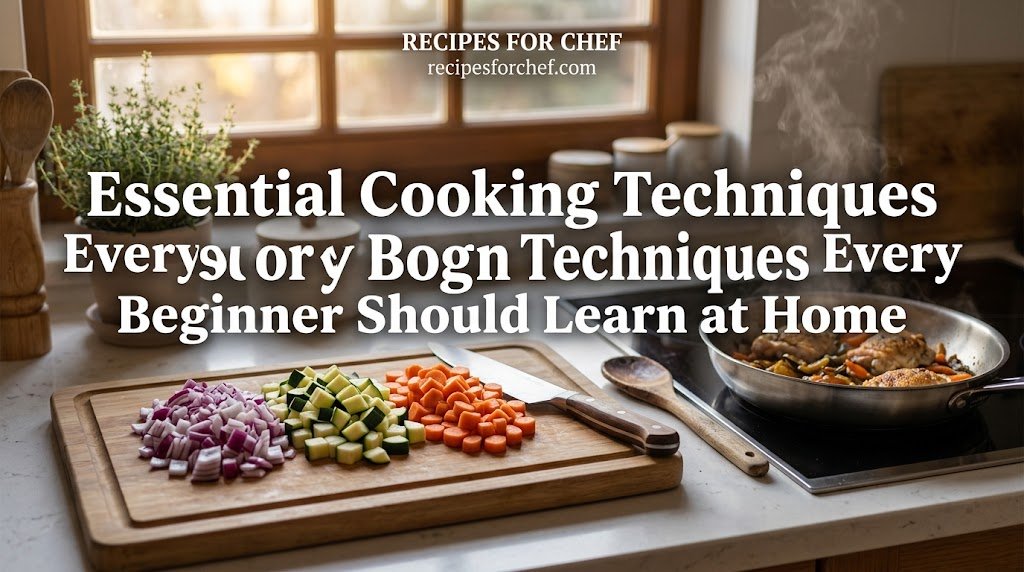
Learning to cook becomes much easier when you stop thinking of recipes as a collection of instructions and start understanding the techniques behind them. Once you know how to control heat, cut ingredients safely, season food, brown meat, cook vegetables, and build simple sauces, many recipes become far less intimidating.
A beginner does not need to master dozens of complicated methods. A small group of reliable techniques covers a surprisingly large part of everyday home cooking.
The important part is knowing what you should see, hear, and feel during each stage. A pan that is too cold will leave food pale and watery. A pan that is too hot can burn the outside before the inside is ready. Vegetables can be crisp, tender, or mushy depending on only a few minutes of cooking time.
This guide explains the most useful cooking techniques to learn first, why they work, common mistakes, and how to recognize when you are doing them correctly.
1. Learning How to Control Heat
Heat control is one of the most important cooking skills because the same ingredient can produce very different results at different temperatures.
High heat is useful when you want fast browning, such as when searing a steak or quickly stir-frying vegetables.
Medium heat gives you more control for tasks such as sautéing onions, cooking chicken pieces, or reducing a sauce.
Low heat is useful when food needs gentle cooking, such as simmering a delicate sauce or slowly softening vegetables.
The mistake many beginners make is treating the burner setting as the same thing as the actual cooking temperature. A pan continues to heat even after you reduce the burner, and different cookware responds at different speeds.
Learn to watch the food rather than relying only on the dial.
If oil is smoking heavily, the pan may be too hot for the ingredient. If food sits quietly without browning, the pan may not be hot enough.
2. How to Sauté Vegetables Properly
Sautéing means cooking relatively small pieces of food quickly in a small amount of fat.
It is one of the most useful techniques for everyday cooking.
Start by heating the pan, then add the appropriate amount of oil or butter. Add the vegetables once the pan is ready.
Do not overcrowd the pan. If too many vegetables are packed together, they release moisture and can begin steaming instead of developing the browned edges you may want.
Cut vegetables into reasonably similar sizes so they cook at roughly the same rate.
Pay attention to texture. Onions may become soft and translucent before eventually browning. Bell peppers can remain slightly crisp or become very tender depending on the dish.
There is no universal point at which every vegetable is “done.” The desired texture depends on how you intend to serve it.
3. How to Sear Food for Better Browning
Searing is the process of using relatively high heat to develop browning on the surface of food.
It is particularly useful for meat, fish, tofu, and some vegetables.
Before searing, pat food dry when appropriate. Excess surface moisture can interfere with browning because water must evaporate before the surface can become hot enough to brown effectively.
Heat the pan and add a suitable amount of cooking fat.
Place the food into the pan without moving it constantly. If you shift a piece every few seconds, it may not remain in contact with the hot surface long enough to develop good browning.
Once a crust has developed, turn the food and continue cooking according to the recipe.
Remember that browning and cooking the center are two different goals. A beautifully browned piece of chicken can still require additional cooking before it is safe to eat.
4. Learning to Sweat Onions and Aromatics
“Sweating” onions means cooking them gently in fat so they soften without developing significant browning.
This is a useful foundation for soups, sauces, stews, curries, and many other dishes.
Use moderate heat and stir occasionally.
If the onions begin browning when you want them soft and pale, reduce the heat.
Garlic requires particular attention because it can burn quickly. Burned garlic develops a harsh flavor that can affect the whole dish.
Once you understand how onions and garlic change during cooking, you will have a better foundation for building flavor in countless recipes.
5. How to Roast Vegetables
Roasting uses dry heat, usually in an oven, to cook food while encouraging browning on its surface.
Cut vegetables into similar-sized pieces and coat them lightly with oil and seasonings.
Spread them out on the baking tray rather than creating a thick pile.
Space matters because vegetables release moisture as they cook. If they are crowded, the moisture has less opportunity to escape, and the vegetables may soften without becoming nicely browned.
Turn or toss them when appropriate so several surfaces have a chance to contact the hot tray.
Look for the signs that matter: tender centers, browned edges, and a texture suited to the vegetable.
6. How to Simmer Instead of Boil
A simmer is gentler than a full boil.
When a recipe says to simmer, you generally want small, steady bubbles rather than vigorous bubbling across the entire surface.
Simmering is useful for soups, sauces, stews, grains, and many braised dishes.
A hard boil can cause delicate ingredients to break apart, evaporate liquid too quickly, or make a sauce difficult to control.
Bring the liquid to the required temperature first, then reduce the heat to maintain a steady simmer.
The right heat setting depends on your stove and cookware, so watch the pot rather than assuming a particular burner number always produces the same result.
7. How to Boil Pasta Correctly
Pasta is simple, but a few details make a major difference.
Use enough water to allow the pasta to move freely.
Bring the water to a proper boil before adding the pasta.
Salt the cooking water according to the recipe or your normal cooking practice.
Stir after adding the pasta so strands do not stick together.
Do not rely entirely on the package cooking time. Start tasting toward the lower end of the suggested range, particularly if you prefer pasta with some firmness.
Before draining, reserve some pasta water if you are making a sauce. The starchy liquid can help loosen a thick sauce and help it coat the noodles.
For most hot pasta dishes, transfer the drained pasta directly into the sauce rather than leaving it in a colander for several minutes.
8. How to Cook Rice Without Making It Mushy
Rice becomes easier to cook once you understand the relationship between rice, water, heat, and time.
Different types of rice require different amounts of liquid and cooking times, so follow the instructions for the specific variety.
One common mistake is repeatedly lifting the lid while rice cooks. Each time the lid is removed, heat and steam escape.
Use the correct liquid ratio, bring the mixture to the appropriate stage, then reduce the heat as instructed.
Once cooked, allow the rice to rest if the recipe calls for it. Fluff gently with a fork rather than aggressively stirring it.
If rice turns mushy, too much liquid or excessive cooking is often involved. If it remains hard, it may need additional cooking liquid or time, depending on what happened during preparation.
9. How to Steam Vegetables
Steaming cooks food using hot steam rather than immersing it directly in water.
It is particularly useful for vegetables when you want them tender while retaining some structure.
Cut vegetables into similar sizes.
Bring the water beneath the steamer to a suitable simmer, but make sure the vegetables sit above the water rather than directly in it.
Cover the pot so the steam stays inside.
Cooking time varies considerably. Thin green beans may need much less time than dense root vegetables.
Check the texture rather than waiting for a universal number of minutes.
A well-steamed vegetable should be cooked through but should not automatically be soft enough to fall apart.
10. How to Poach Delicate Foods
Poaching uses relatively gentle heat to cook food in liquid.
It is useful for delicate ingredients that could become damaged by aggressive boiling.
The liquid should generally remain below a vigorous boil.
Poaching is commonly associated with foods such as eggs and certain fish preparations.
The key beginner skill is controlling the temperature. If the liquid is bubbling violently, the food may break apart or cook too aggressively.
Use a suitable pan with enough liquid to surround the food.
11. How to Cook Eggs With Better Control
Eggs are excellent for learning heat control because small temperature changes can produce noticeably different textures.
For scrambled eggs, moderate or lower heat gives you more time to control the texture. Stir gently and remove them from the heat when they are nearly at the desired consistency because residual heat can continue cooking them.
For fried eggs, control the burner so the whites set without burning the bottom.
For boiled eggs, timing and cooling are important because the eggs continue changing as they remain hot.
Eggs also provide a useful lesson: “done” is not always a single texture. The right result depends on the dish you are making.
12. How to Make a Simple Pan Sauce
A pan sauce is a practical technique that can turn the flavorful residue left in a skillet into part of the finished meal.
After cooking meat or vegetables, you may see browned bits attached to the bottom of the pan.
These browned pieces can contribute a lot of flavor.
Add an appropriate liquid, such as stock or another ingredient specified by the recipe, and gently loosen the browned bits with a wooden spoon.
Allow the liquid to reduce until the sauce reaches the desired concentration.
You can then finish the sauce according to the recipe, sometimes with butter, cream, herbs, or another ingredient.
The important lesson is to distinguish browned residue from burnt residue. Dark, bitter, charred material should not automatically be scraped into the sauce.
13. How to Thicken a Sauce
There are several ways to thicken a sauce, and each produces a different result.
Reduction removes water through simmering.
A roux uses flour cooked with fat before liquid is incorporated.
Cornstarch can provide quick thickening when mixed into a suitable slurry.
Cream, cheese, puréed vegetables, and other ingredients can also contribute body.
The best method depends on the sauce.
Beginners often make the mistake of adding too much thickener because a sauce looks thin while it is still cooking. Remember that many sauces become thicker as they cool.
Add thickening agents gradually and give them time to work before deciding whether more is needed.
14. How to Season Food in Layers
Good seasoning is not simply about adding salt at the end.
When appropriate, season different components as they cook.
For example, lightly seasoning vegetables while they sauté can produce a more integrated result than leaving all seasoning until the plate.
However, not every ingredient should be salted heavily at every stage.
Foods such as stock, cheese, cured meat, soy sauce, and packaged sauces may already contain salt.
Taste as you cook.
Acidic ingredients such as lemon juice or vinegar can also change how a dish tastes without simply making it saltier.
The goal is not maximum seasoning. It is a flavor balance that suits the dish.
15. How to Taste Food While Cooking
Tasting is a cooking technique in itself.
You learn whether the dish needs more salt, more acidity, additional cooking time, or another adjustment.
Taste at useful stages rather than only at the very end.
For a sauce, taste after reducing because concentration changes the flavor.
For soup, taste after the ingredients have cooked enough to contribute their flavors.
For a finished dish, taste before serving and consider whether the flavors are balanced.
Always use a clean utensil for tasting rather than repeatedly placing the same utensil back into the food.
16. How to Cut Ingredients Evenly
Knife skills are about more than speed.
Consistent cuts help ingredients cook at similar rates.
If a pan contains large chunks of carrot alongside tiny pieces, the small pieces may become soft before the larger ones are cooked through.
Start with a stable cutting board and a sharp, suitable knife.
Keep your fingers curled away from the blade and use controlled movements.
You do not need to chop extremely quickly. Accuracy and control are more valuable for a beginner.
As your confidence improves, speed will naturally follow.
17. How to Deglaze a Pan
Deglazing is similar to the beginning of a pan sauce.
After cooking, browned bits may remain on the bottom of the pan.
Add an appropriate liquid while the pan is still warm, then scrape the bottom gently with a suitable utensil.
The liquid loosens the browned material and incorporates it into the sauce.
This technique is useful with meat, poultry, vegetables, and many skillet dishes.
Again, learn to recognize the difference between flavorful browned residue and burned food. Burnt bits can make an entire sauce bitter.
18. How to Cook Food in Batches
Batch cooking is particularly useful when searing or sautéing.
If you add too much food to a pan at once, the temperature can drop and moisture can build up.
Instead of browning, food may steam.
Cooking in smaller batches gives each piece better contact with the hot surface.
You can then combine everything again once the initial browning is complete.
This technique takes a little longer, but the difference in texture can be significant.
19. How to Rest Meat Before Slicing
Resting is a useful technique for larger cuts of cooked meat.
When meat comes off the heat, allow it to rest for a suitable period before slicing.
This gives the internal heat and juices time to settle.
Cutting immediately can result in more liquid running onto the cutting board.
The exact resting time depends on the size and type of meat, so follow the recipe when one is provided.
For poultry and other foods where food safety matters, use a food thermometer and appropriate cooking guidance rather than relying on resting time to determine whether the food is safe.
20. How to Finish a Dish With Fresh Ingredients
Finishing ingredients can add a final layer of flavor and texture.
Fresh herbs, citrus zest, a small amount of lemon juice, grated cheese, toasted nuts, or a drizzle of suitable oil can change the character of a dish.
The important part is restraint.
A finishing ingredient should support the dish rather than cover everything else.
For example, a little lemon juice can brighten a rich sauce, while fresh herbs can add freshness to a hearty soup.
Taste first, then decide what the dish is missing.
Common Beginner Cooking Mistakes
Using High Heat for Everything
High heat is useful for some techniques but can burn delicate ingredients.
Overcrowding the Pan
Too much food can lower the pan temperature and prevent proper browning.
Adding Too Much Flour to Sticky Dough
A slightly sticky dough is not necessarily defective. Excess flour can make bread heavy.
Ignoring Ingredient Size
Uneven cuts can lead to uneven cooking.
Salting Without Tasting
Adding salt repeatedly without tasting can quickly push a dish too far.
Following Time Without Watching the Food
Recipe times are useful guides, but cookware, ingredients, and heat vary.
Trying to Fix Everything at Once
Make one adjustment, observe the result, then decide whether another change is necessary.
How to Practice These Techniques at Home
You do not need to practice every technique separately.
Choose familiar meals that naturally teach several skills.
A simple vegetable pasta can teach knife skills, sautéing, boiling, seasoning, sauce consistency, and pasta timing.
A roasted chicken dinner can teach oven heat, seasoning, browning, and temperature checking.
A vegetable soup can teach sautéing aromatics, simmering, seasoning, and tasting.
Repeating simple dishes is useful because you can notice how small changes affect the final result.
Keep notes if a particular method works especially well for your cookware or kitchen.
A Practical Beginner’s Cooking Setup
A basic kitchen does not need dozens of specialized tools.
A useful starter collection includes a sharp chef’s knife, cutting board, large skillet, saucepan, baking tray, wooden spoon or heat-safe spatula, measuring spoons and cups, and a kitchen thermometer.
A digital kitchen scale is especially helpful for baking and recipes where ingredient ratios matter.
A food thermometer is valuable when cooking meat, poultry, and other foods where internal temperature is important.
Good equipment helps, but learning how food responds to heat is more important than buying expensive cookware.
How to Know When You Are Improving
You are making progress when you begin noticing changes before the food becomes a problem.
You hear a pan becoming more active when food hits the surface.
You recognize when onions are beginning to brown.
You can tell when a sauce needs more reduction.
You know when dough needs rest instead of more flour.
You start tasting before serving rather than discovering at the table that something is too salty.
These are signs that you are learning to cook rather than simply following instructions.
Image Opportunities for This Article
[Image suggestion: Beginner preparing vegetables with safe knife technique]
[Image suggestion: Vegetables being sautéed in a spacious skillet]
[Image suggestion: Steak or chicken being seared without overcrowding the pan]
[Image suggestion: Sauce being reduced and checked for consistency]
[Image suggestion: Cooked pasta being tossed with sauce and reserved pasta water]
Frequently Asked Questions
What cooking technique should a beginner learn first?
Heat control is an excellent starting point because it affects almost everything else. Learning how to adjust between high, medium, and low heat helps with sautéing, searing, simmering, sauces, eggs, and many other dishes.
How can I stop food from sticking to my pan?
Use appropriate cookware, preheat the pan when the recipe calls for it, use enough cooking fat, and avoid moving food before it has had time to develop a cooked surface. However, not all sticking is bad; browned residue can be useful when making a pan sauce.
Why does my food not brown properly?
A crowded pan, excess surface moisture, or insufficient heat can prevent browning. Cook in batches when necessary and pat appropriate ingredients dry before searing.
How do I know when vegetables are cooked?
Use texture as your main guide. Depending on the dish, vegetables may be crisp-tender, tender, or very soft. Taste a piece when it is close to the expected cooking time instead of relying entirely on a timer.
Should beginners always cook with high heat?
No. Different techniques need different levels of heat. High heat can be useful for searing, while sauces, eggs, and delicate ingredients often benefit from gentler cooking.
Why should I taste food while cooking?
Tasting helps you identify seasoning and texture problems before serving. It allows you to make small adjustments instead of trying to correct the entire dish at the end.
Do I need expensive equipment to become a better cook?
No. A few reliable tools are enough for most home cooking. Heat control, knife safety, seasoning, timing, and understanding texture have a much greater effect on your results than expensive equipment.
Final Thoughts
Good cooking starts with a handful of techniques that you can use across many different recipes.
Learn to control heat, sauté vegetables, sear food, simmer gently, boil pasta, roast vegetables, season in stages, build simple sauces, and judge doneness by texture and temperature. These skills will make recipes easier to understand because you will know what the instructions are trying to achieve.
Do not worry about becoming fast immediately. Focus on recognizing what is happening in the pan and making small adjustments when needed. With repetition, those observations become natural, and everyday cooking becomes much less stressful.