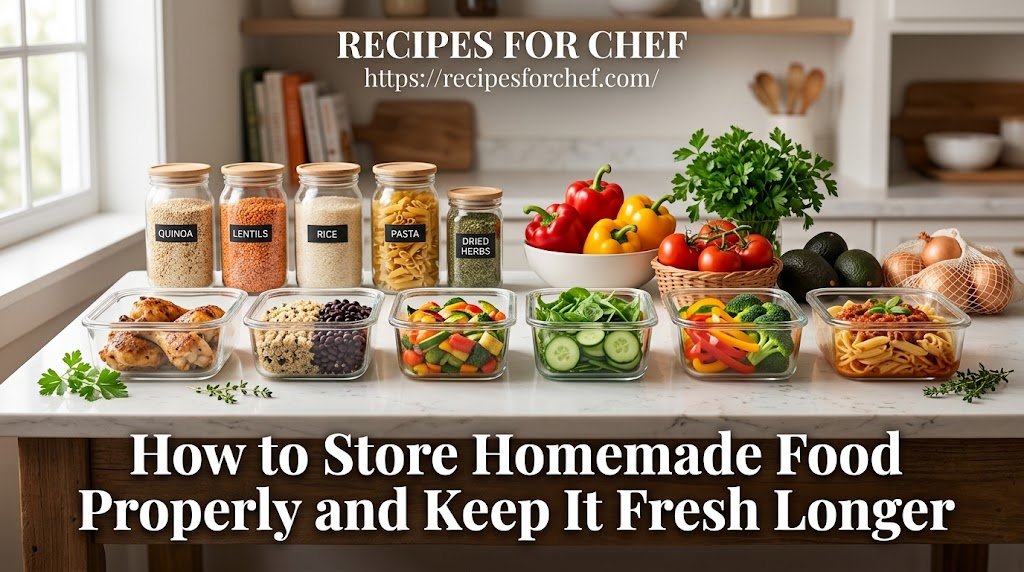
Cooking a large pot of soup, making extra rice for tomorrow, or preparing several portions of dinner can make everyday meals much easier. The challenge comes afterward: how do you store that food so it stays safe, tastes good, and does not turn soggy, dry, stale, or unpleasant?
Good food storage is about more than putting leftovers in the refrigerator. The container, temperature, portion size, moisture, timing, and type of food all matter.
A crispy chicken coating needs very different storage from cooked rice. Fresh herbs need different treatment from a bowl of soup. Bread can become stale in the refrigerator, while cooked meat should be chilled promptly.
This guide explains practical ways to store common homemade foods while protecting both quality and food safety. It also covers cooling leftovers, choosing containers, freezing meals, avoiding freezer burn, and reheating food without ruining its texture.
Why Proper Food Storage Matters
Storage affects two things at the same time: safety and quality.
From a safety perspective, perishable food should not sit at room temperature for too long. The FDA recommends refrigerating or freezing leftovers and other perishable foods within two hours, or within one hour when the surrounding temperature is above 90°F (32°C).
From a quality perspective, food can deteriorate even when it remains safe. Vegetables can lose their crispness, rice can become hard or sticky, sauces can separate, and cooked foods can absorb unwanted refrigerator odors.
Good storage tries to control both problems.
Start With the Right Refrigerator Temperature
Your refrigerator should be kept at 40°F (4°C) or below, while your freezer should be at 0°F (-18°C). An inexpensive appliance thermometer is useful because the number shown on the refrigerator dial does not always represent the actual temperature inside.
Do not assume that the coldest setting is automatically better for every food. What matters is maintaining a reliably cold, stable temperature without freezing foods that should remain refrigerated.
Avoid packing the refrigerator so tightly that cold air cannot circulate. The FDA specifically recommends avoiding overpacking for this reason.
Refrigerate Leftovers Promptly
One of the most important storage habits is simple: do not leave cooked perishable food sitting on the counter for hours.
Leftovers should generally be refrigerated or frozen within two hours. If the surrounding temperature is above 90°F (32°C), the limit is one hour.
This is particularly important for cooked meat, poultry, seafood, eggs, dairy-based dishes, cooked vegetables, soups, stews, casseroles, and rice dishes.
You do not need to wait for a large pot of food to reach room temperature before putting it into the refrigerator. In fact, the FDA recommends dividing large amounts of leftovers into shallow containers to help them cool more quickly.
Divide Large Batches Into Smaller Containers
Suppose you have made a large pot of chicken soup.
Putting the entire hot pot into one deep container can make cooling slower. Instead, divide the soup into several shallow containers or smaller portions.
This has another advantage: you only reheat what you plan to eat.
Smaller portions also make freezing easier. A single large frozen block can take much longer to thaw than several individual portions.
Leave enough space for foods that expand when frozen, particularly soups, stews, and liquids.
Choose Containers Based on the Food
A container should protect food from air, moisture loss, spills, odors, and contamination.
For refrigerator storage, containers with secure lids are generally practical. The FDA recommends keeping refrigerated foods covered in containers or sealed storage bags.
Glass containers are useful for many cooked foods because they are sturdy and easy to clean. Food-safe plastic containers are lighter and convenient for lunches or freezer storage.
The most important thing is not whether the container looks attractive. It should be clean, food-safe, appropriately sized, and capable of closing securely.
Do Not Leave Too Much Empty Space
Air inside a container can contribute to quality loss, particularly during freezer storage.
For foods that are simply refrigerated for a day or two, a little air is usually not a major issue.
For longer freezer storage, however, reducing unnecessary air exposure can help protect texture and flavor.
This is especially useful for cooked meat, vegetables, sauces, and other foods susceptible to freezer burn.
Label Your Food Before You Forget What It Is
A container of frozen brown food can be surprisingly difficult to identify a few weeks later.
Label containers with the food name and the date it was stored.
For freezer meals, you can also note the number of portions.
This simple habit helps you use older food first and prevents perfectly good meals from being forgotten behind newer containers.
How Long Do Homemade Leftovers Last?
For many cooked leftovers, a useful general guideline is three to four days in the refrigerator when they have been handled and stored properly. USDA guidance gives this range for cooked leftovers.
That does not mean every homemade food has exactly the same storage life.
Ingredients, preparation, temperature, handling, and storage conditions all matter.
If you are unsure whether a particular food is safe, do not rely on smell or appearance alone. Some harmful bacteria may not produce an obvious odor or visible change.
For specific foods, use reliable food-storage guidance rather than guessing.
Store Soups and Stews Properly
Soups and stews are among the easiest foods to prepare ahead.
Once cooked, divide a large batch into smaller, shallow containers and refrigerate promptly.
For longer storage, freezing works well for many soups and stews.
USDA guidance lists approximately three to four days for refrigerated leftovers and several months in the freezer for quality purposes, with exact freezer times varying by food.
Some ingredients change texture after freezing.
Potatoes, cream-based ingredients, and certain vegetables may become softer or separate after thawing. A soup can still be useful, but it may not have exactly the same texture as when freshly cooked.
If you know a soup will be frozen, consider adding delicate garnishes, fresh herbs, noodles, or crunchy toppings after reheating rather than freezing them with the soup.
Store Cooked Rice With Extra Care
Cooked rice deserves particular attention because cooked rice can support the growth of harmful bacteria if it is handled improperly.
After cooking, refrigerate rice promptly rather than leaving it at room temperature for an extended period.
Divide a large batch into shallow containers so it cools more quickly.
Once refrigerated, keep the rice cold and use it within the recommended leftover-storage period. Do not repeatedly move it from the refrigerator to the counter and back again.
For fried rice or another reheated rice dish, reheat only the portion you intend to eat.
Keep Crispy Foods Away From Moisture
Crispy foods are among the hardest leftovers to store well.
Fried chicken, roasted potatoes, breaded vegetables, fried fish, and similar foods contain a crisp outer surface that quickly loses its texture when trapped in a humid container.
If you put hot crispy food into a tightly sealed container, steam becomes trapped. That moisture softens the coating.
For best quality, allow the food to stop steaming before closing the container, while still following the food-safety requirement to refrigerate perishable foods promptly.
When reheating, an oven, toaster oven, air fryer, or suitable skillet can often restore more crispness than a microwave.
The microwave heats through moisture, which is convenient but rarely produces a crisp crust.
Store Sauces Separately When Possible
If you have cooked pasta, roasted vegetables, fried chicken, or another food with a crisp or firm texture, consider storing the sauce separately.
A sauce poured over food before refrigeration can gradually soften the surface.
Keeping them separate gives you more control when serving.
This works particularly well with:
- Pasta sauces
- Gravy
- Dipping sauces
- Salad dressings
- Creamy sauces
- Stir-fry sauces
The same principle applies to toppings. Fresh herbs, toasted nuts, crispy onions, croutons, and similar ingredients are usually better added after reheating.
Store Fresh Herbs Carefully
Fresh herbs can deteriorate quickly because they lose moisture or become exposed to excess moisture.
The best storage approach depends on the herb.
Tender herbs such as parsley and cilantro can often be kept refrigerated with their stems in a small amount of water and loosely covered, similar to a small bouquet.
Hardier herbs such as rosemary and thyme generally tolerate refrigerator storage better when wrapped appropriately and protected from excessive moisture.
Avoid washing delicate herbs and then sealing them while they are dripping wet. Excess moisture can encourage decay.
If you wash herbs before storage, drying them thoroughly is important.
Store Cut Vegetables Properly
Once vegetables are cut, their exposed surfaces lose moisture more quickly and can deteriorate faster.
Refrigerate cut vegetables in clean, suitable containers.
Some vegetables benefit from being kept relatively dry, while others can tolerate more moisture.
For leafy greens, excess water can encourage wilting or decay. A clean towel or suitable absorbent material can help manage moisture in a storage container.
The goal is not to make every vegetable completely dry. It is to avoid trapping unnecessary water around foods that are sensitive to it.
Keep Raw and Cooked Foods Separate
Food storage is also about preventing cross-contamination.
Raw meat, poultry, seafood, and eggs should be kept away from ready-to-eat foods.
A practical refrigerator habit is to place raw meat or seafood in a sealed container or leak-proof package on a lower shelf, where accidental drips are less likely to contaminate foods below.
Keep cooked foods covered.
Clean spills promptly, particularly juices from raw meat and poultry. The FDA notes that cleaning spills helps reduce the risk of cross-contamination.
Store Bread Differently From Most Leftovers
Bread is a good example of why “put everything in the refrigerator” is not a universal storage rule.
Refrigeration can make bread become stale more quickly because of changes in the starch structure.
If you expect to eat bread within a short period, room-temperature storage in an appropriate bread bag or container may preserve its texture better.
For longer storage, freezing is often more useful.
Slice a loaf before freezing if you expect to use individual portions. That way, you can remove only what you need instead of repeatedly thawing the entire loaf.
Store Pasta Without Letting It Become a Solid Block
Cooked pasta can become sticky as it cools because its surface starch changes.
Tossing it with a small amount of suitable sauce can help keep portions separate, depending on the final dish.
For pasta that will be reheated with sauce, avoid storing it submerged in excessive sauce if you want to preserve a particular texture.
When reheating plain pasta, a little moisture can help soften it again.
Do not expect refrigerated pasta to have exactly the same texture as freshly cooked pasta. Proper storage can preserve it well, but reheating is still part of the process.
Store Meat and Chicken in Portions
If you have cooked a large amount of chicken, beef, pork, or another meat, divide it into portions before refrigerating or freezing.
This makes reheating easier and prevents you from repeatedly heating the entire batch.
For freezer storage, wrap meat securely and use a container or bag that limits air exposure.
If you freeze cooked chicken for later use in sandwiches, salads, soups, or wraps, portion it according to how you expect to use it.
A few small containers are often more useful than one huge frozen package.
Freeze Food Before It Becomes a Problem
Freezing is particularly useful when you already know you will not eat the leftovers within the refrigerator storage period.
Do not wait until the food has been sitting in the refrigerator for several days before deciding to freeze it.
Freeze it while it is still properly stored and within the recommended safe-storage period.
USDA guidance notes that frozen leftovers can remain safe for long periods when continuously kept at 0°F (-18°C), although quality can decline over time.
Freezing protects safety, but it does not stop quality changes completely.
Protect Food From Freezer Burn
Freezer burn is mainly a quality problem caused by moisture loss and air exposure.
Food with freezer burn may develop dry, pale, leathery patches.
To reduce it, use packaging that fits the food reasonably well and limits air exposure.
For example, remove unnecessary air from a freezer bag before sealing it.
For longer storage, wrapping the food well and then placing it inside a freezer-safe container or bag can provide another layer of protection.
Thaw Frozen Food Safely
Do not thaw perishable food by simply leaving it on the kitchen counter.
FDA guidance recommends three safe thawing approaches: in the refrigerator, in cold water, or in the microwave. Food thawed in cold water or the microwave should be cooked immediately.
Refrigerator thawing is usually the easiest method when you have enough time.
For example, move tomorrow’s frozen chicken or soup from the freezer to the refrigerator the night before.
Cold-water thawing is faster but requires more attention.
Microwave thawing is useful when time is short, but the food should be cooked immediately afterward.
Reheat Only What You Need
Repeated reheating can affect texture and quality.
Instead of reheating an entire container of food, take out one serving.
This is particularly useful with rice, pasta, meat, vegetables, and casseroles.
For soups, sauces, and gravies, stir during reheating so the heat is distributed evenly.
If using a microwave, cover food appropriately, stir or rotate when needed, and allow standing time so the heat can distribute through the food.
Use a food thermometer when appropriate to verify safe reheating rather than relying only on the appearance of the food.
Avoid Reheating Crispy Food in the Microwave
A microwave is excellent for convenience, but it is usually not the best tool for restoring crispness.
Moisture inside the food turns into steam, which can soften coatings.
For fried chicken, roasted potatoes, breaded vegetables, and similar foods, reheating in an oven, toaster oven, air fryer, or skillet may give a better texture.
Use moderate heat and monitor the food so the outside does not burn before the center becomes hot.
Do Not Keep Repeatedly Opening the Freezer
Every time you open the freezer, warm air enters.
For everyday use, this is not a major concern, but frequent long openings can make the freezer work harder and create temperature fluctuations.
Organize frozen food so frequently used items are easy to find.
Labeling containers helps too.
A freezer that looks chaotic tends to become a freezer where food gets forgotten.
Use Older Food First
A simple “first in, first out” system can reduce waste.
When you prepare something new, place it behind older containers.
Keep older leftovers toward the front so they are easier to see.
Once a week, check what needs to be eaten soon.
This small routine can prevent a refrigerator from becoming a collection of forgotten containers.
Signs That Food Should Not Be Eaten
Food should not be eaten simply because it “looks okay.”
Some harmful microorganisms do not cause obvious changes in smell or appearance.
If food has been stored improperly, left unrefrigerated too long, or you cannot establish how long it has been stored, it is safer to discard it rather than taste it to find out.
The FDA advises that questionable food should not be treated casually and uses the principle, “When in doubt, throw it out.”
Do not taste food that you suspect has spoiled.
Common Food Storage Mistakes
Putting a Large Hot Pot Straight Into One Deep Container
Large quantities cool slowly. Divide them into smaller, shallow containers instead.
Leaving Food on the Counter Until It “Fully Cools”
Perishable food should be refrigerated or frozen within the recommended time rather than sitting out for hours.
Storing Everything in the Refrigerator
Not every food benefits from refrigeration. Bread is a good example where freezing or appropriate room-temperature storage may preserve quality better.
Leaving Containers Uncovered
Uncovered food can lose moisture and absorb odors. Use secure lids or suitable storage bags.
Overfilling the Refrigerator
Cold air needs room to circulate. An overloaded refrigerator may not cool food evenly.
Freezing Food in Large Blocks
Large frozen portions are harder to thaw and reheat. Portion meals before freezing.
Ignoring Date and Storage Information
Write the storage date on leftovers and use reliable storage guidelines rather than guessing.
A Simple Storage Routine After Cooking
You can make food storage much easier by following the same basic routine after every meal.
First, decide what will be eaten immediately.
Next, divide leftovers into sensible portions.
Transfer them into clean, suitable containers.
Refrigerate or freeze perishable food within the recommended time.
Label anything you are unlikely to remember later.
Move older food toward the front of the refrigerator.
Freeze portions that you know you will not use within the recommended refrigerator-storage period.
This takes only a few minutes once it becomes habitual.
Frequently Asked Questions
How long can homemade leftovers stay in the refrigerator?
Many properly handled cooked leftovers can be kept for three to four days in a refrigerator maintained at 40°F (4°C) or below. Specific foods can have different recommendations, so use food-specific guidance when available.
Should I let hot food cool completely before refrigerating it?
No. You should not leave perishable food sitting at room temperature until it is completely cool. Divide large amounts into shallow containers to help them cool quickly, then refrigerate promptly.
What temperature should my refrigerator be?
Keep the refrigerator at 40°F (4°C) or below and the freezer at 0°F (-18°C). An appliance thermometer can help you verify the actual temperature.
Is it better to freeze food in large containers or small portions?
Small portions are usually more practical. They cool and freeze more efficiently, thaw more easily, and allow you to reheat only what you need.
Can I thaw homemade food on the kitchen counter?
For perishable food, no. Use the refrigerator, cold water, or microwave instead. Food thawed using cold water or a microwave should be cooked immediately.
How can I keep leftover fried food crispy?
Store the food so excess steam does not become trapped, and reheat it using dry heat such as an oven, toaster oven, air fryer, or skillet. Keep sauces and wet toppings separate when practical.
When should I throw away stored food?
Discard food that has been stored improperly, left out too long, or kept beyond recommended storage periods. Do not taste questionable food to determine whether it is safe. When there is genuine uncertainty, it is safer to discard it.
Final Thoughts
Good food storage starts before the container goes into the refrigerator.
Cool large batches efficiently by dividing them into smaller portions, keep your refrigerator at 40°F (4°C) or below, cover food properly, and label leftovers so they do not disappear into the back of the fridge.
For the best quality, think about the food itself. Keep sauces separate from crispy foods, protect freezer meals from excess air, store herbs according to their moisture needs, and reheat only the amount you plan to eat.
Most importantly, do not take chances with food that has been stored incorrectly or for too long. A little organization can save food and money, but safe handling should always come first.